

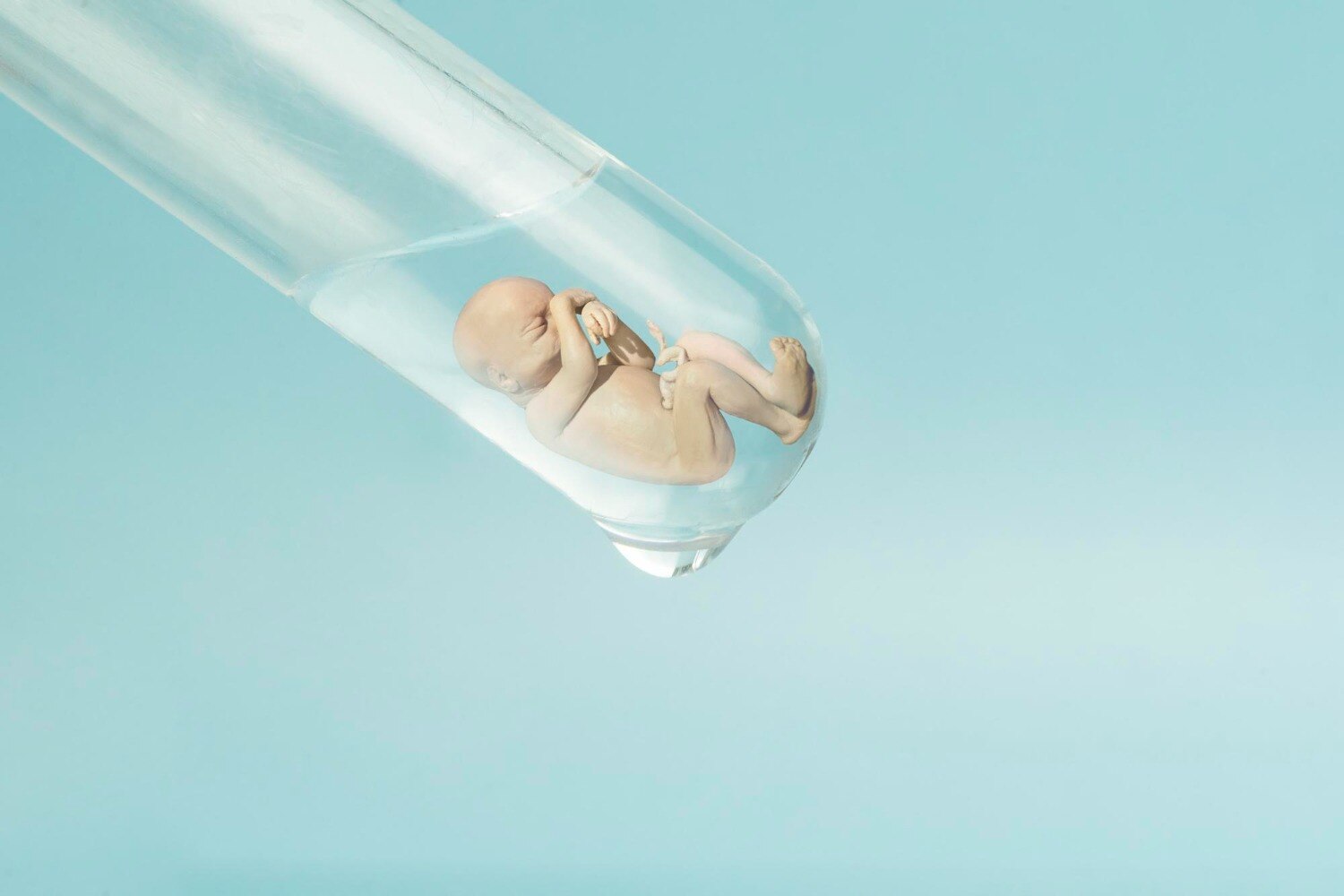
A “test tube baby” is an informal name for a baby conceived through in-vitro fertilisation, or IVF: eggs and sperm meet in a laboratory, but the embryo develops after transfer to the uterus. You will be able to follow each stage, understand the tests and injections involved, and compare transfer choices without treating embryo grade or a positive pregnancy test as a guarantee.
Key takeaways
- IVF joins eggs and sperm in a laboratory before transferring an embryo to the uterus.
- Fertility testing checks ovarian reserve, sperm health, the uterus, and fallopian tubes.
- Ovarian stimulation uses medication, ultrasound scans, blood tests, and a timed trigger injection.
- Pregnancy is confirmed with a blood beta-hCG test after embryo transfer.
What “test tube baby” means and where the IVF journey begins
The test tube baby meaning is a baby conceived through in-vitro fertilisation (IVF), not a baby grown in a test tube. Eggs and sperm meet in a laboratory, an embryo develops for about 2–6 days, and the embryo is transferred into the uterus, where implantation and pregnancy occur.
The IVF consultation begins with an assessment of both partners, not just the woman.
- The doctor reviews menstrual cycles, previous pregnancies, medical conditions, surgeries, medicines, fertility history, and the duration of attempts to conceive.
- Testing examines ovulation, ovarian reserve, the uterus, fallopian tubes, and sperm. Common tests include hormone blood tests, AMH, antral follicle count, ultrasound, tubal-patency imaging, and semen analysis.
- The results identify the likely cause, explain treatment choices, and establish whether IVF is appropriate. The plan also covers medication timing, expected monitoring, risks, and consent.
- Treatment starts on a specified cycle day, with instructions for injections, scans, and blood tests.
The IVF process then moves through ovarian stimulation, ultrasound and hormone monitoring, a trigger injection, egg retrieval, sperm collection, fertilisation, embryo culture, and embryo transfer. Conventional IVF places prepared sperm beside the eggs; ICSI injects one sperm into an egg when severe male-factor infertility or previous fertilisation failure makes it appropriate.
Which fertility tests are done before IVF, and when do they happen?
Testing usually starts during the initial fertility evaluation, before anyone chooses IVF. Both partners are assessed: ovulation, egg supply, sperm, the uterine cavity, and fallopian-tube openness can each change the recommended treatment.
| Test | When it happens | What it assesses |
|---|---|---|
| Ovulation assessment | Cycle history; urine LH testing, or blood progesterone about 7 days before the expected period | Whether ovulation occurs and when |
| AMH test | Any menstrual-cycle day | Expected response to stimulation; not a stand-alone fertility or live-birth test |
| Antral follicle count | Transvaginal ultrasound, usually on cycle days 2–5 | Small resting follicles and likely egg yield |
| Semen analysis | At the first evaluation; repeat after an abnormal result, following the laboratory’s abstinence instructions | Sperm count, movement, and shape |
| Uterine assessment | Transvaginal ultrasound; saline sonography or hysteroscopy when the cavity needs closer inspection | Fibroids, polyps, adhesions, or an unusual cavity shape |
| Tubal patency test | After menstruation ends and before ovulation | Whether each fallopian tube is open, using HSG or HyCoSy |
The AMH test and antral follicle count help predict how the ovaries may respond to injectable medicines. They do not reliably predict whether you will conceive naturally or have a live birth.
A semen analysis is essential even when ovulation or ultrasound findings look normal. If results show severe male-factor infertility, the clinic may discuss ICSI rather than conventional IVF; the choice depends on the complete evaluation.
What happens during ovarian stimulation, monitoring, trigger, and egg retrieval?
Stimulation usually starts early in the menstrual cycle and lasts about 8–14 days. You give daily ovarian stimulation injections containing follicle-stimulating hormones to recruit several follicles, rather than produce one unusually large egg. A second injection may prevent premature ovulation.
IVF monitoring shows how the follicles are growing and when the dose needs adjustment. Clinics repeat transvaginal ultrasound scans every few days and sometimes measure blood estradiol. The aim is to balance follicle development: stopping too early can reduce the egg yield, while excessive stimulation raises the risk of ovarian hyperstimulation syndrome.
- Trigger injection: Once enough follicles reach the target size, you take the final maturation injection at an exact time.
- Egg retrieval: The procedure is scheduled about 34–36 hours later, before spontaneous ovulation is expected.
- Recovery: You usually receive sedation or anaesthesia while a clinician guides a needle through the vagina into each follicle and removes its fluid and egg.
- Aftercare: Arrange an adult escort, rest for the remainder of the day, and expect cramping, pelvic soreness, or light spotting. Follow your clinic’s instructions about fasting and medication.
Not every follicle contains an egg, and not every collected egg is mature. Contact the clinic urgently for severe or worsening abdominal pain, breathing difficulty, faintness, persistent vomiting, or rapidly increasing abdominal swelling. A sperm sample is often provided on retrieval day unless frozen or donor sperm has already been arranged.
How eggs become embryos in the laboratory and reach the uterus
After egg retrieval, prepared sperm is combined with each mature egg in the laboratory. Conventional IVF places many prepared sperm around an egg and allows one to fertilise it.
ICSI injects a single sperm directly into the egg, mainly for severe male-factor infertility or previous fertilisation failure; it is not automatically better when sperm function is adequate.
| Option | How fertilisation happens | When it is used |
|---|---|---|
| Conventional IVF | Prepared sperm are placed around the egg | Sperm function is adequate |
| ICSI | One sperm is injected into the egg | Severe male-factor infertility or earlier fertilisation failure |
Successful fertilisation produces embryos that remain in embryo culture for several days. Embryo grading records how the cells divide, how even they look, and how much fragmentation is present. A higher grade ranks an embryo more favourably, but it cannot prove normal chromosomes or guarantee implantation. Some embryos stop developing before transfer or freezing.
Transfer can occur at the cleavage stage on day 2 or 3, or as a blastocyst transfer on day 5 or 6. Extending culture to day 5 or 6 helps distinguish embryos that continue developing, but it also means embryos that arrest in culture are unavailable for transfer.
An embryo is placed through a thin catheter into the uterus; implantation then occurs inside the body. If transfer is not done fresh, the embryo can be vitrified and transferred in a later cycle.
How clinics choose fresh or frozen transfer and confirm pregnancy
Transfer timing is chosen around your hormone levels, uterine lining, embryo stage, and OHSS risk—not simply the day embryos are ready.
A fresh embryo transfer usually occurs 2–6 days after egg retrieval; a frozen embryo transfer uses vitrified embryos in a later cycle, allowing hormone levels to settle and reducing OHSS risk when stimulation has produced a strong response.
| Option | What it means | When it applies |
|---|---|---|
| Fresh embryo transfer | Transfer during the retrieval cycle | Hormone levels and lining are suitable, with no significant OHSS concern |
| Frozen embryo transfer | Thaw and transfer an embryo in a later cycle | OHSS risk, high progesterone, medical concerns, or a planned later attempt |
| Single embryo transfer | Place one good-quality embryo | Preferred when a suitable embryo is available to reduce twin or higher-order pregnancy |
Transferring two embryos raises the chance of twins, preterm birth, low birth weight, hypertension, and gestational diabetes. Progesterone support after retrieval or transfer helps maintain the uterine lining because stimulation can disrupt normal luteal hormone production. Do not stop it after a home test without medical advice.
A clinic confirms pregnancy with a timed blood hCG test, usually after the date it provides, then uses ultrasound to confirm the pregnancy’s location and development.
Ask Dr Shikha Sardana to state whether figures are IVF success rates per cycle, retrieval, transfer, or thaw; also separate pregnancy from live-birth rates and check the age, diagnosis, treatment type, and whether results are cumulative.
Related service
Comprehensive Fertility Evaluation & Female/Male Infertility Treatment Comprehensive Fertility Evaluation & Female/Male Infertility Treatment Dr Shikha Sardana offers comprehensive fertility evaluation and personalized infertility treatment for both women and men to identify the underlying... View service → |
Frequently asked questions
What does “test tube baby” mean?
A test tube baby is conceived through in-vitro fertilisation, or IVF. Eggs and sperm meet in a laboratory, an embryo develops for about 2–6 days, and the embryo is transferred to the uterus.
Which fertility tests happen before IVF?
Before IVF, evaluation can include ovarian reserve tests such as AMH and antral follicle count, hormone testing, semen analysis, and an ultrasound of the uterus and ovaries. Your clinician may also assess the fallopian tubes and screen for infections based on your history.
What happens during ovarian stimulation and egg retrieval?
You use prescribed stimulation medicines while the clinic tracks follicle growth with transvaginal ultrasound and blood tests. A trigger injection completes final egg maturation, and egg retrieval follows under ultrasound guidance, usually with sedation.
How do eggs become embryos during IVF?
The laboratory fertilises mature eggs with sperm using standard insemination or intracytoplasmic sperm injection. Embryos are observed as they develop for about 2–6 days before the clinic selects one for transfer or freezes suitable embryos.
How does a clinic choose between fresh and frozen embryo transfer?
A fresh transfer takes place in the same treatment cycle when the uterine lining and hormone levels are suitable. A frozen transfer uses a later natural or hormone-prepared cycle, which allows the clinic to postpone transfer when the body needs recovery or additional planning.